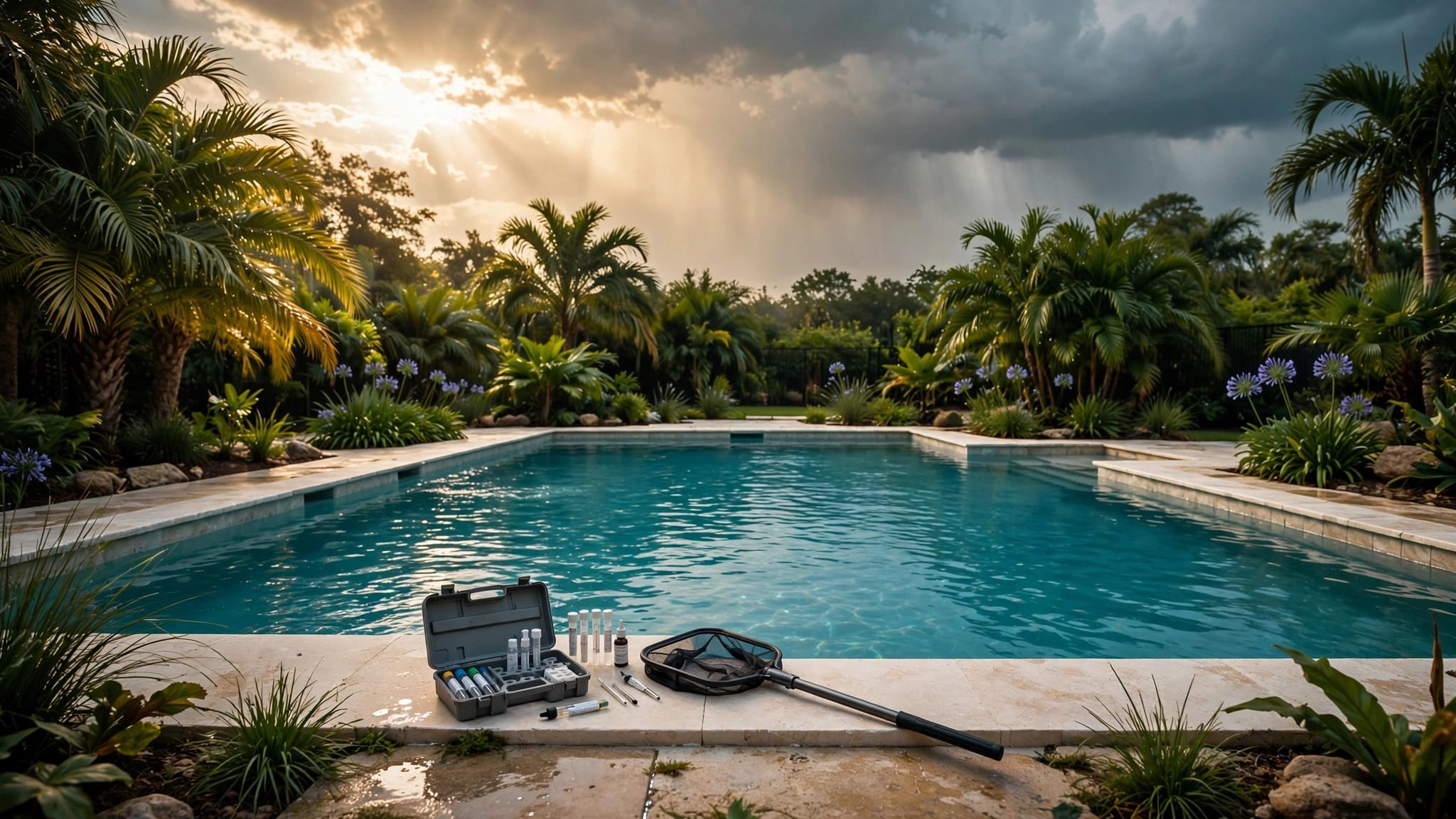
A chemical dose based on the wrong pool size can leave your water undertreated or push readings too high. Knowing your pool water volume gives you a reliable starting point, but you also need current test results and the product label.
The measurement homeowners most often overlook is actual average depth , especially when the pool has a sloping floor or tanning ledge. Start with the water your pool holds today, then calculate its gallons before reaching for chemicals.
Key Takeaways
- Measure inside the pool at its current waterline, and record water depth rather than the shell's full height.
- Use the shallow-end and deep-end average only when the floor slopes evenly across a consistent-width pool.
- Calculate ledges, benches, and connected sections separately when they change the pool's shape or depth.
- Base every chemical addition on measured gallons, current test results, and the directions on that specific product.
Why Pool Water Volume Changes Every Chemical Dose
Chemical labels often express treatment amounts per a stated number of gallons. If your estimate is wrong, the concentration you create will also be wrong.
For example, treating a 15,000-gallon pool as though it holds 20,000 gallons means adding about 33% more product than intended. That difference matters when adjusting sanitizer, alkalinity, or calcium hardness.
However, volume alone doesn't tell you what the water needs. Two equally sized pools can require different treatments because their starting readings differ.
Your gallon estimate also supports equipment planning. During new pool construction in Cape Coral, ask for the completed pool's calculated capacity, including any connected features. Keep that information with your equipment manuals.
Even with a builder's estimate, check the dimensions and operating water level before using it for routine dosing.
Measure the Pool's Actual Average Depth
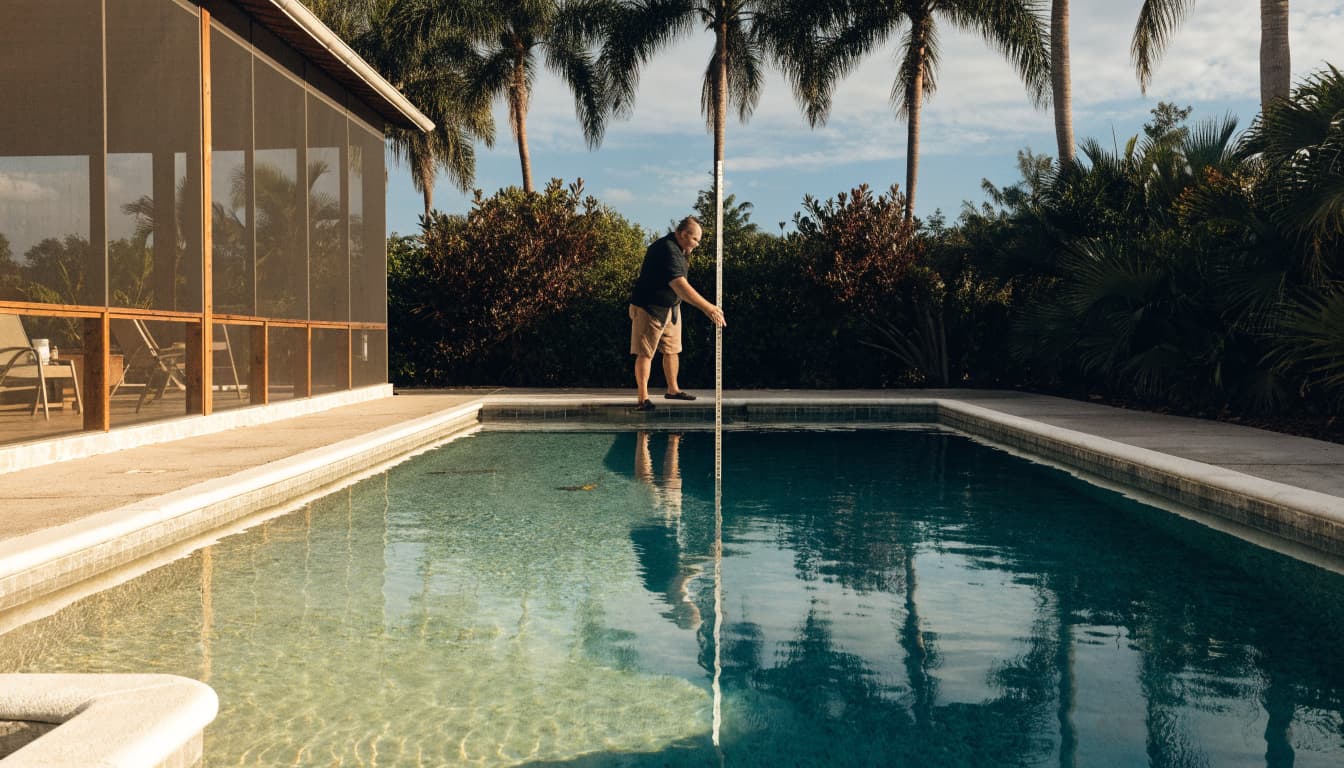
Measure from a stable position on the deck whenever possible. Use a tape measure for horizontal dimensions and a suitable measuring pole for depth.
Record Interior Dimensions and Water Depth
Measure the water-containing interior, not the coping, deck, or outside shell. For a rectangular pool, record its interior length and width.
Next, measure vertically from the water surface to the floor at several locations. Don't measure from the deck surface, because that includes space above the water.
Keep every measurement in feet before calculating. For example, 4 feet 6 inches equals 4.5 feet. Entering 4.6 feet would introduce an error.
Record the current water level, too. A partially drained pool contains less water than it does at its normal operating level.
Account for Slopes and Flat Sections
For an evenly sloping, constant-width pool, calculate average depth this way:
Average depth = (shallow depth + deep depth) ÷ 2
A pool measuring 3 feet at one end and 6 feet at the other has a 4.5-foot average under those conditions.
However, that shortcut becomes less reliable when the pool has long flat sections, a diving well, or changing widths. Divide those areas into sections and calculate each section's volume.
Averaging only the shallowest and deepest measurements can misstate gallons when those depths occupy unequal portions of the pool.
For an irregular floor, equally spaced depth measurements provide a better picture than two endpoint readings. A builder's dimensional calculation is preferable for complex designs.
Calculate Pool Water Volume by Shape
One cubic foot holds approximately 7.48 US gallons. Multiplying the pool's water-filled cubic footage by that conversion gives its estimated capacity.
These formulas use measurements in feet and return US gallons.
| Pool shape | Estimated volume formula |
|---|---|
| Rectangle | Length × width × average depth × 7.48 |
| Circle | Diameter × diameter × average depth × 5.9 |
| Oval | Length × width × average depth × 5.9 |
The circle and oval factors are rounded. An oval formula assumes an ellipse, so it won't accurately describe every rounded pool.
Rectangular Pool: A Worked Calculation
For a pool measuring 32 feet long, 16 feet wide, and 4.5 feet deep on average:
32 × 16 × 4.5 = 2,304 cubic feet
Then convert cubic feet to gallons:
2,304 × 7.48 = 17,233.92 gallons
Round the result to approximately 17,234 gallons for your maintenance record. The decimal doesn't make the estimate more accurate than your measurements.
Using the common rounded conversion of 7.5 instead would give 17,280 gallons. That small difference is usually less important than an inaccurate depth measurement.
Round and Oval Pools Need Different Dimensions
For a circular pool, measure the interior diameter across its center. Don't use the radius in a formula that calls for diameter.
For an oval pool, measure the longest interior length and the widest perpendicular width. Then multiply by the actual average water depth and the rounded 5.9 factor.
A kidney-shaped pool isn't an ellipse. Applying an oval formula to it can overestimate water where the inward curve removes area.
Also, check the units in any online calculator. A calculator expecting meters cannot use your measurements in feet without conversion.
Handle Freeform Pools, Ledges, Benches, and Spas
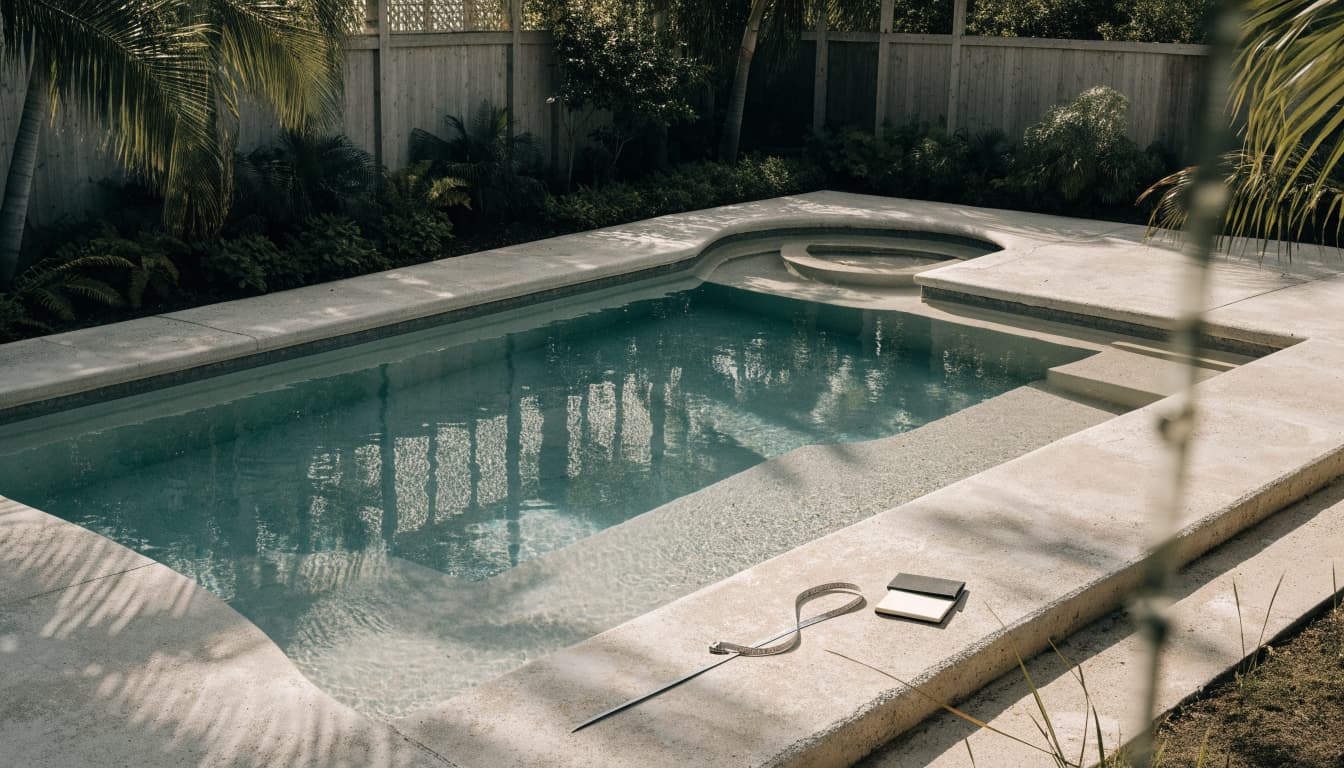
For a freeform pool, sketch the water surface and divide it into simpler, nonoverlapping sections. Calculate each section using its own dimensions and average depth, then add the results.
A tanning ledge needs its shallow water depth. Applying the main pool's average depth to that area would count water that isn't there.
Built-in steps and benches also displace water. If your initial calculation treats those spaces as open water, subtract their submerged solid volume.
Be careful with curved edges. Measuring a rectangle around the entire pool includes areas outside the actual basin. That shortcut can create a substantial overestimate.
An attached spa requires attention to the valve configuration. Include its water when the treatment will circulate through both the pool and spa as one connected body. When the spa operates separately, calculate and treat it separately according to the system's instructions.
Don't count the same overlapping area twice when combining sections.
For complicated designs, ask your builder or renovation contractor for a capacity calculation based on the finished dimensions. Construction drawings can help, but they should match the pool as built and its normal water level. Keep the separate pool and spa capacities in your records.
Turn Gallons Into a Label-Based Chemical Dose
A correct gallon estimate is one part of dosing. The other parts are your starting reading, desired adjustment, and the product's instructions.
Test First and Identify the Required Change
Take a clean water sample away from return jets, skimmers, and chemical feeders. Collect it below the surface, around elbow depth.
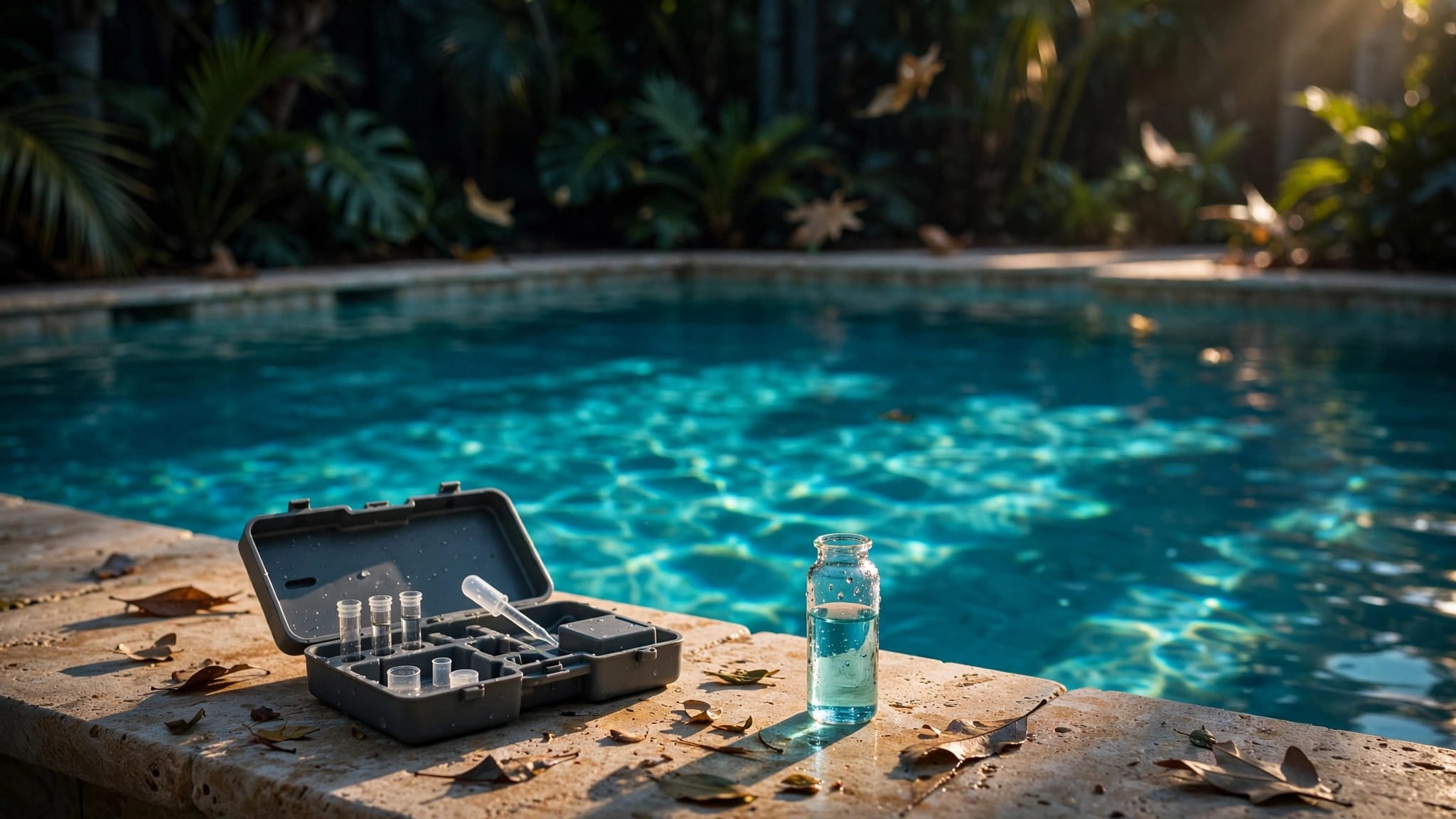
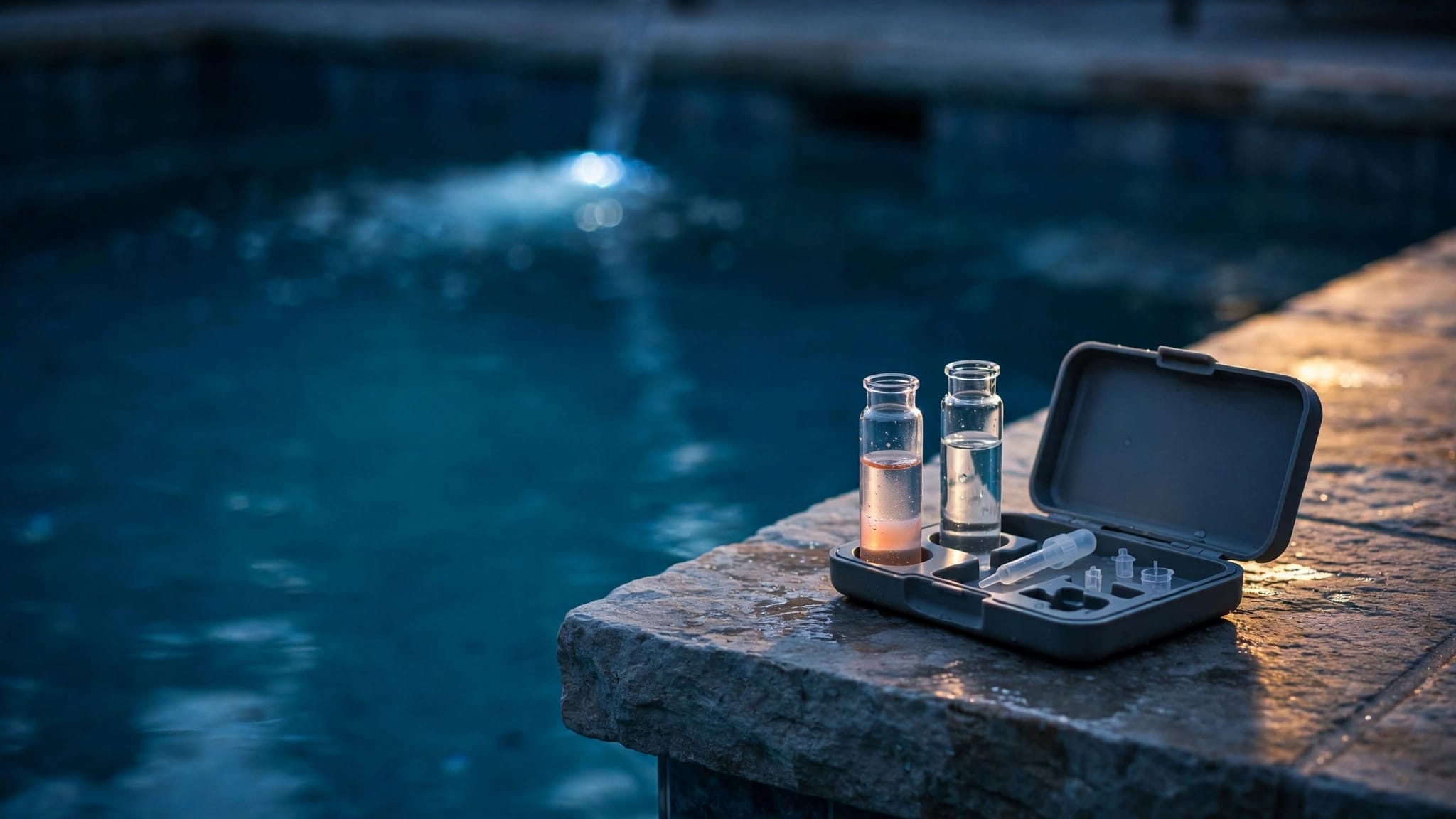
Use a reliable liquid kit, such as a Taylor K-2006, or obtain a professional water test. Check the readings relevant to the treatment, including sanitizer, pH, alkalinity, calcium hardness, and stabilizer.
Don't choose a treatment from water appearance alone. Clear water can still have unsuitable chemistry.
When both alkalinity and pH need correction, a typical balancing routine addresses alkalinity first, then reassesses pH. Follow the product directions and any requirements for your pool finish.
Scale the Label Amount to Your Pool
When a product gives an amount per 10,000 gallons, calculate your volume multiplier:
17,234 ÷ 10,000 = 1.7234
For the rectangular pool above, multiply the applicable label amount by 1.7234. Use the label amount corresponding to your measured reading and intended adjustment.
This doesn't establish a universal chemical dose. Different concentrations require different quantities, even when products treat the same problem.
Keep weight ounces and fluid ounces separate. Use the measuring method specified on the container.
Add products separately and follow the label's circulation, application, protective-equipment, and swimming restrictions. Never mix pool chemicals in a bucket or feeder.
Retest after the required circulation period before making another adjustment. Also, don't assume that a calculated turnover time equals the label's mixing or re-entry time.
Keep Your Gallon Estimate Useful After Pool Changes
Write down your dimensions, depth measurements, calculation method, and estimated gallons. Include the water level at the time you measured.
That record makes future treatments easier. It also helps a pool professional check whether repeated dosing problems come from inaccurate capacity information.
Recalculate after work that changes the basin, such as adding a tanning ledge, enlarging steps, or installing a connected spa. When planning pool renovations and resurfacing, ask whether the proposed changes will affect water capacity.
A new screen enclosure doesn't change gallons. However, shade, weather exposure, and swimming activity can affect treatment demand, so testing remains necessary.
In Cape Coral, heavy rain and fresh fill water can shift chemistry. Test again after major weather events or substantial refilling rather than repeating the previous dose automatically.
Your volume record also supports circulation calculations. For example, a 15,000-gallon pool flowing at an actual 50 gallons per minute has a calculated turnover time of:
15,000 ÷ 50 = 300 minutes, or 5 hours
That figure describes water movement equivalent to the pool's capacity. It doesn't prove that every gallon passed through the filter or that a treatment has finished working.
If water stays difficult to balance, don't keep increasing chemical amounts. Check the measurements, test results, and circulation. Persistent problems or visible finish damage deserve an on-site evaluation.
Make Accurate Gallons the Starting Point
Reliable pool water volume starts with measured water depth and a calculation that fits the pool's shape. Then current test results and the specific product label determine what you add.
Keep your gallon estimate with your maintenance records, and update it after changes to the basin. That prevents a guessed capacity from becoming a repeated dosing mistake.
If you're planning a new pool or renovation, Get a Free Estimate to schedule an on-site consultation with Back Bay Pools.