Florida pools should remain part of family life when stairs become hard to manage. Pool accessibility lifts move a seated swimmer between the deck and water, which can support independent use or a more controlled assisted transfer.
The right lift has to fit more than the waterline. Deck width, coping, enclosure doors, power, salt air, and the user's needs all affect the decision. Start with how the lift will be used, then plan its location before a build or renovation begins.
How a Residential Pool Lift Supports Access
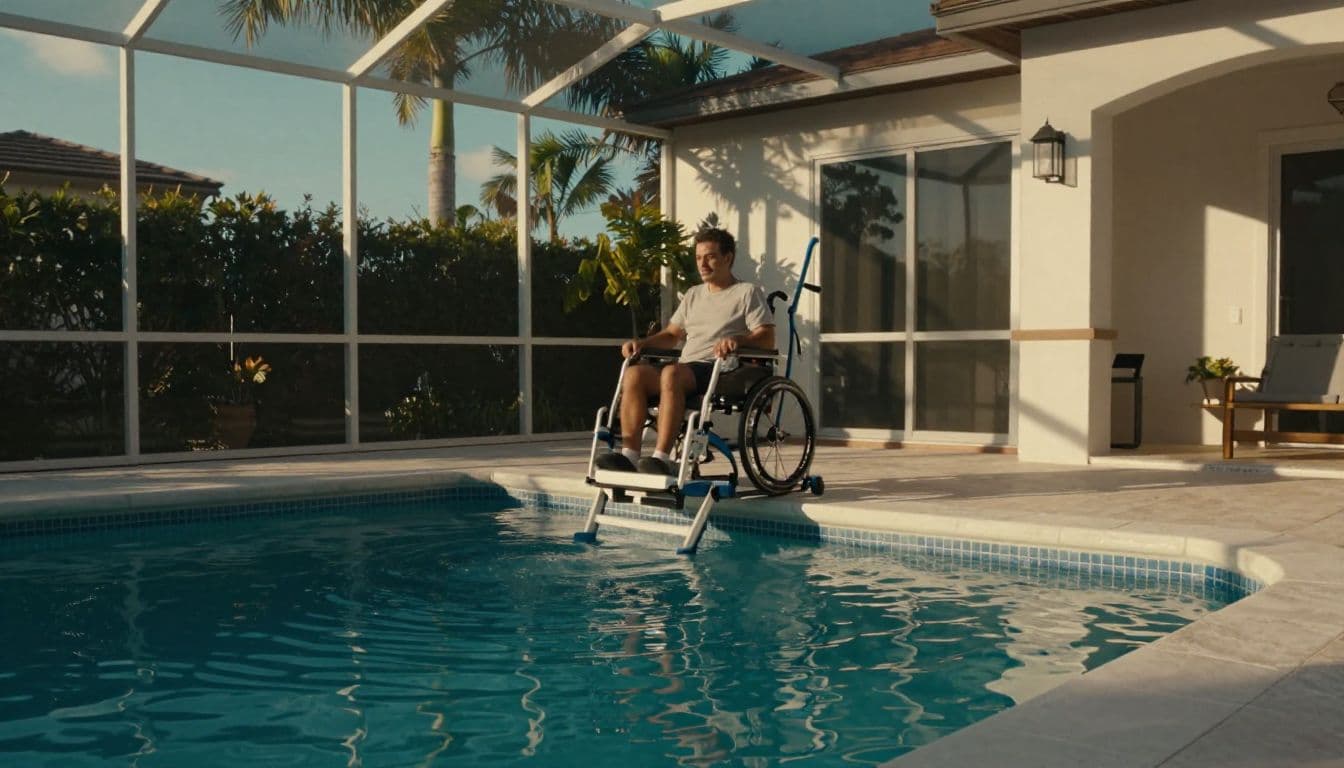
A pool lift rotates a seated person from the deck into the pool and back out again. It can reduce the challenge of wet steps, steep ladder rungs, and uneven footing near the water.
The lift should feel like part of the pool area, not an obstacle squeezed between furniture and a screen door. Placement, controls, and transfer space all matter as much as the lift itself.
Independent use depends on the full setup
A lift can give a swimmer more control over entering and leaving the water. However, independent operation depends on the user's ability to transfer to the seat and use the controls as the manufacturer directs.
Keep the route from the home, patio, or wheelchair parking area clear. Also, choose a location with room to approach the seat without turning around tight furniture, planters, or pool equipment.
Assisted transfers need clear working room
For assisted use, a helper needs stable footing beside the seat and enough open deck to work safely. The helper should not need to step over hoses, pool toys, or raised drainage channels.
A lift's listed capacity does not authorize a second person to ride along. Ask the manufacturer how the model is designed to handle assisted transfers, including any approved seatbelt, armrest, or footrest features.
Choosing Pool Accessibility Lifts: Portable or Fixed
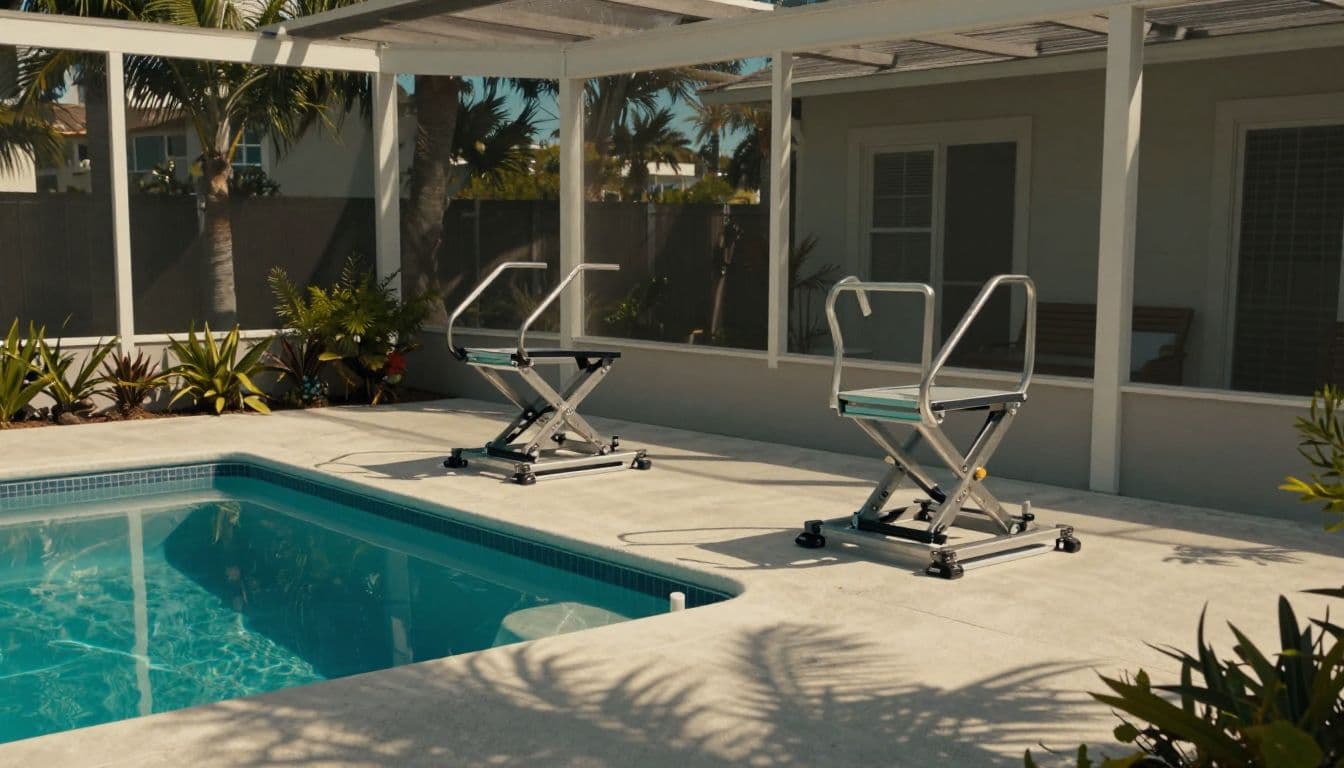
The better installation type depends on how often the lift will be used and how permanent you want the setup to be. Portable units can offer flexibility, while deck-anchored lifts keep the transfer point consistent.
Portable lifts can suit changing layouts
A portable lift may work well during a remodel, in a backyard with more than one possible entry point, or where homeowners want to remove equipment between uses. S.R.Smith lists no-anchor and caddy configurations for some aXs2 lift options.
Still, portable does not mean it can sit anywhere on the deck. The unit needs a stable, level surface and a planned storage location. Check turning clearance, wheel access, and the manufacturer's instructions before moving it.
Permanently installed lifts create a dedicated entry point
A fixed lift mounts to a deck anchor at a selected pool edge. That makes the entry location predictable, which can be helpful for routine use. However, the anchor, deck structure, and surrounding clearance need attention before installation.
For example, S.R.Smith's Splash! 300 manual lists anchor reaction loads that must be considered during installation. A pool professional should review the actual deck and anchoring method rather than relying on a generic detail.
| Option | Often fits best when | Main planning issue |
|---|---|---|
| Portable lift | The layout may change or equipment needs storage | Level movement path and secure parking space |
| Fixed lift | The same entry point will be used regularly | Anchor location, deck structure, and clear deck area |
A portable model can still require a designated spot, while a fixed model needs early coordination.
Match Capacity, Seat Design, and Power to the User
Lift specifications are practical limits, not broad comfort estimates. Compare models using the rider's expected load, transfer needs, and the pool's physical layout.
Start with the manufacturer's rated load
S.R.Smith lists 300-pound lifting capacities for its aXs2 and PAL2 residential lifts. Its Splash! 300 owner's manual lists a 400-pound lifting capacity. Those figures are model-specific, so confirm the current manual before ordering.
Ask how the manufacturer defines the maximum permitted load, especially if the rider uses flotation equipment or other personal items. Also, confirm the approved rider capacity. Never assume a second person can share the seat.
Seat dimensions affect transfers, too. S.R.Smith's PAL documentation lists a 23-inch-wide seat and a raised seat position of roughly 16 to 19 inches from the deck. A seat that aligns well with a mobility device or patio chair can make transfers more manageable.
Compare battery, water-powered, and remote-control operation
Many residential lifts use rechargeable battery power. The aXs2 uses a 24-volt rechargeable battery, while S.R.Smith documents 24-volt DC battery power for the Splash! 300. That manual estimates about 30 cycles per charge, although actual use depends on conditions and battery health.
Water-powered systems use water pressure rather than a rechargeable battery. They avoid battery charging, but they also require suitable plumbing, pressure, and manufacturer-approved installation details. Confirm local availability and service support before choosing one.
Ask the supplier to identify the exact controls included with the lift. That conversation should cover hand controls, fixed buttons, optional remote controls, charging indicators, and the approved response if the unit stops mid-transfer.
A lift with enough lifting capacity can still be a poor fit if the seat, controls, or transfer area do not work for the person using it.
Plan the Deck, Water Depth, and Anchor Location
A well-placed lift needs open deck space on both sides of the transfer. Measure before selecting a model, especially in compact lanais where furniture, railings, and screen doors already compete for space.
Leave room for the transfer area
S.R.Smith's PAL literature calls for a 36-by-48-inch clear deck area on the side of the seat opposite the pool. Florida Department of Health pool checklist guidance also notes a minimum 4-foot-wide deck behind a deck-mounted lift.
Use those measurements as planning guidance, not as a universal approval stamp. Each model has its own dimensions, anchor setback, reach, and water-depth limits. PAL documentation, for example, identifies a maximum 48-inch water depth at the entry point.
Keep pool rails in the same plan. Pool step handrail placement guidance can help homeowners avoid conflicts between a lift, stairs, rails, screen framing, and door swings.
Coordinate the lift with a renovation or new build
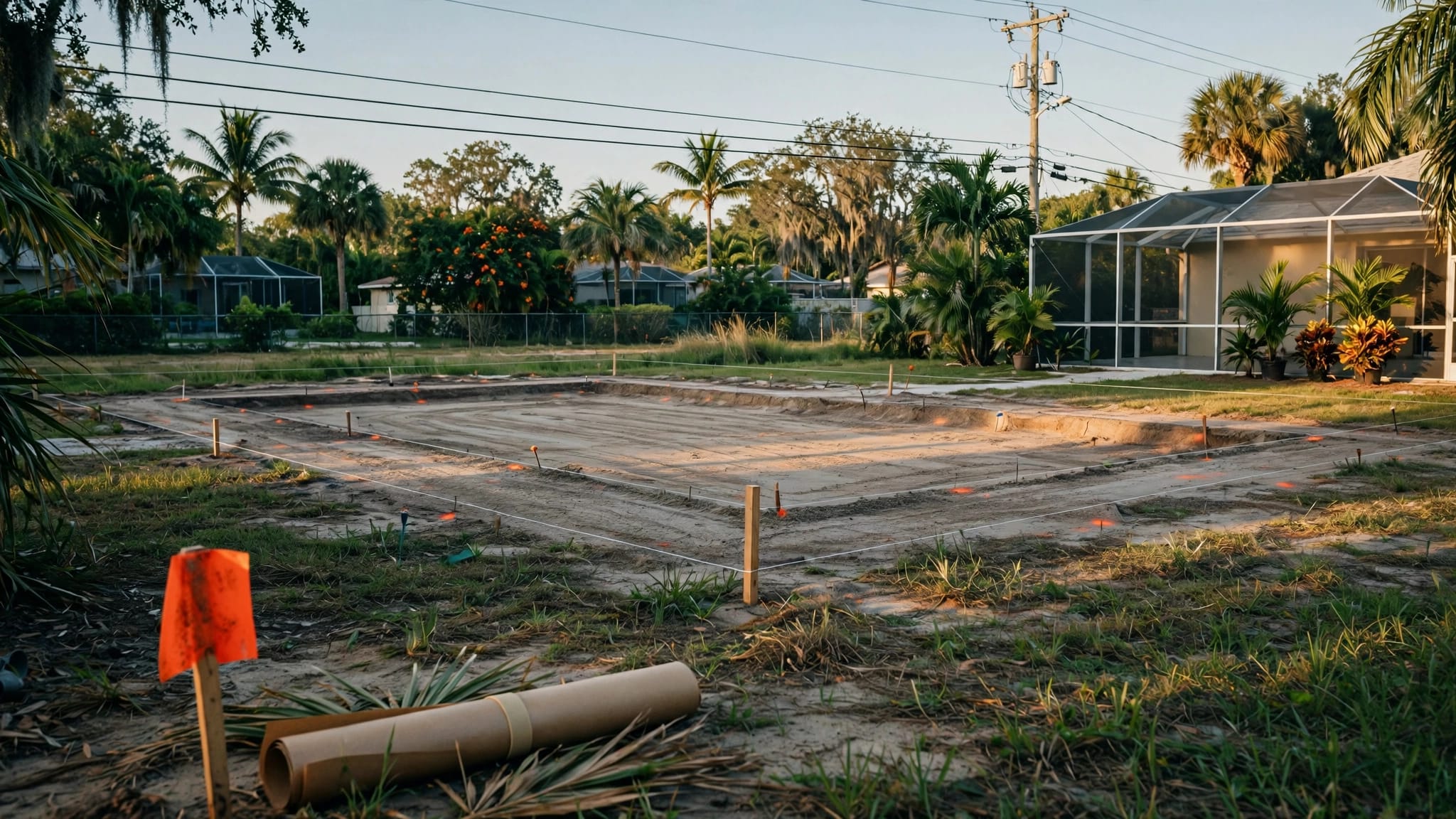
New pool construction gives you the cleanest chance to reserve deck space, locate anchors, and keep the lift near a preferred entry area. During resurfacing or a deck renovation, plan the lift before the new finish goes down.
A proposal should show lift placement, anchor work, electrical or plumbing needs, deck repair, and any required enclosure changes as separate scope items. Reviewing what to look for in a pool proposal helps keep those details visible before work starts.
Florida Conditions and General Compliance Guidance
Florida weather is tough on outdoor equipment. Sun, rain, chlorinated splash, saltwater systems, and coastal air all deserve attention when selecting a residential pool lift.
Choose materials that hold up outdoors
S.R.Smith describes the aXs2 as powder-coated stainless steel and aluminum. Those materials can be a sensible starting point for a Florida backyard, yet every lift still needs regular cleaning and inspection.
Salt air can reach inland neighborhoods, and chlorinated water can sit around anchor points after a swim. Look for corrosion-resistant hardware, manufacturer-approved coatings, protected electrical connections, and a charging setup sheltered from direct rain.
Avoid placing the lift where runoff pools around its base. If a screen enclosure is being repaired or replaced, coordinate the lift position with door clearance and future service access.
Keep the lift separate from pool barrier decisions
Florida's private residential pool-barrier rules generally call for a barrier at least 4 feet high, along with self-closing, self-latching gate requirements. A lift does not replace a required barrier or make a gate location less important.
A private home pool does not automatically have the same accessibility obligations as a public pool. However, rental use, community ownership, public access, or other site conditions can change the compliance question.
Treat code information as general guidance. Confirm requirements with your local building department, a licensed pool professional, and the lift manufacturer before buying or installing equipment.
A Buyer Checklist and Maintenance Routine
A good purchase starts with measurements and ends with a clear service plan. Bring these details to an on-site consultation.
Questions to settle before you order
- Measure usable deck width, not only the distance from coping to the screen wall.
- Confirm the lift's rider capacity, seat dimensions, reach, and water-depth requirement.
- Ask whether the model is portable, anchor-mounted, or available in more than one configuration.
- Review battery charging needs or water-powered plumbing requirements.
- Find out whether a remote control is included, optional, or unavailable for that model.
- Check that the anchor location will not interfere with a rail, gate, furniture path, or screen door.
- Request the manufacturer's instructions for emergency operation and servicing.
- Put lift work, deck repairs, and electrical or plumbing items in the written scope.
Keep the lift ready for the next swim
Follow the manufacturer's maintenance schedule rather than relying on a generic calendar. Check the battery charge, control function, seat hardware, straps, armrests, footrests, anchor area, and visible corrosion before use.
Keep the charging equipment dry and protected as the manufacturer directs. After heavy weather or a long period without use, inspect the lift before placing anyone on the seat. Ask the installer to explain the approved emergency procedure if the unit loses power or stops operating.
If the lift is part of a pool renovation, Get a Free Estimate for an on-site look at the deck, pool edge, enclosure, and existing equipment.
A Pool That Stays Part of Home Life
Pool accessibility lifts work best when the equipment, deck, and daily routine all fit together. Capacity matters, but so do transfer space, corrosion resistance, reliable power, and a clear emergency plan.
With careful measurements and model-specific guidance, a Florida pool can remain a more welcoming place for family time, exercise, and quiet afternoons in the water.